Economic development site work rarely moves in a straight line.
A prospect asks for sites. The property list needs cleanup. The parcel boundary has to be checked. The map needs to make sense. The RFI requirements are sitting in a PDF. The report needs to be updated. And eventually, someone has to turn all of that into something clear enough to send.
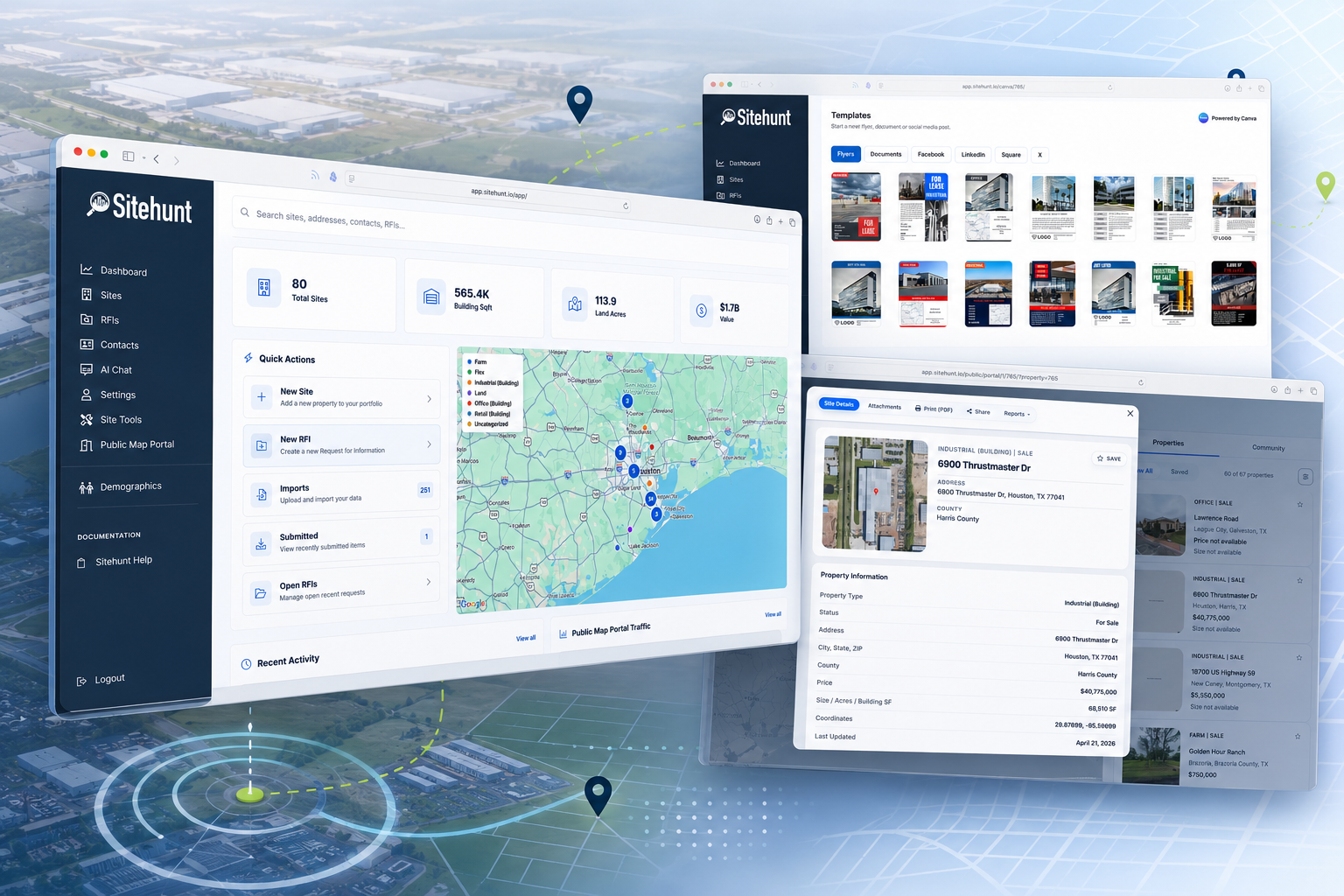
Since January, we have been improving Sitehunt around that full workflow: taking raw site information, making it easier to trust, adding useful context, and helping teams turn it into responses, reports, portals, and marketing materials.
The goal is not another place to store data. The goal is a better working system for the messy middle of site selection.
Start With Cleaner Site Data
Site data often starts messy, so the first improvement is intake and cleanup.
Sitehunt has improved the ways teams import property data, review it before it goes live, check parcel boundaries, verify acreage, merge duplicate sites, track availability, and send clearer import summaries.
That makes the data process less of a black box. Teams can bring in more information without giving up control over quality.
Make the Inventory Easier to Trust
Once the data is in, teams need to move through it quickly.
Sitehunt is faster and easier to use with larger property lists. Teams can search, sort, filter, compare sites, review parcels, check acreage, add photos, and use Street View more naturally inside the same workflow.
Maps have improved too, with clearer markers, popups, legends, clustering, and property-type views.
That matters because everything else depends on the inventory. If an EDO cannot quickly find, trust, and explain its available sites, the RFI, reporting, and marketing work all get harder.
Add the Context Prospects Need
A site is not just a pin on a map.
Sitehunt has improved how it gathers and presents the context around each property: parcels, boundaries, infrastructure, transportation access, airports, workforce, housing, demographics, imagery, and nearby community assets.
Public site and community pages have also improved, with more useful data for prospects to explore. The pages are cleaner, faster, and easier to navigate. Maps are more useful, documents are handled more consistently, and site, property, and community details are easier to understand in one place.
A public portal is often the first version of the community a consultant or company sees. It should answer questions, not create new ones.
Turn the Work Into Responses and Materials
The RFI workflow has improved so teams can more easily upload project documents, pull out key requirements, compare candidate sites, review fit, see results on a map, and export a report.
That makes the process less of a scramble. Instead of rebuilding the work every time, teams can keep documents, requirements, sites, scoring, maps, and reports closer together.
Sitehunt also does more to shorten the distance between site data and the materials teams need to share. Reports have better branding, better demographic handling, clearer loading screens, and faster repeat access once they have been generated. The Canva workflow has improved too, with better support for presentation-style materials, logo maps, and Street View imagery.
The point is simple: fewer manual steps between “we have the data” and “we have something polished we can send.”
Make the Daily Work Smoother
The private workspace is more user friendly, with tighter dashboards, site pages, RFI pages, import pages, settings, navigation, filters, headers, mobile layouts, archive flows, and delete flows.
Sitehunt’s AI work is also becoming more practical. The focus is on real tasks: reviewing RFI documents, helping interpret requirements, improving AI chat, linking answers back to site records, and making it clearer where answers came from.
Behind the scenes, long-running jobs are more reliable. Status messages are clearer. Reports, imports, maps, documents, and AI tasks are less fragile.
Customers may not notice every improvement individually. They should notice fewer stalled tasks, clearer progress, and a smoother experience when Sitehunt is doing heavy work in the background.
The Bigger Picture
Sitehunt is moving more of the site selection process into one connected system.
An EDO should be able to start with raw site data, clean it up, understand the surrounding context, respond to an RFI, publish a public page, create a report, and prepare marketing material without rebuilding the same information over and over again.
That is what we have been improving toward: less handoff, less rework, and a clearer path from available sites to serious project conversations.